
.png)
Atmospheric Water Generators (AWGs) create clean water by cooling air to its dew point (mechanical) or using moisture-absorbing materials (desiccant). While desiccant systems work in low humidity, mechanical cooling is currently the market leader for energy efficiency, production volume, and production density in most climates.
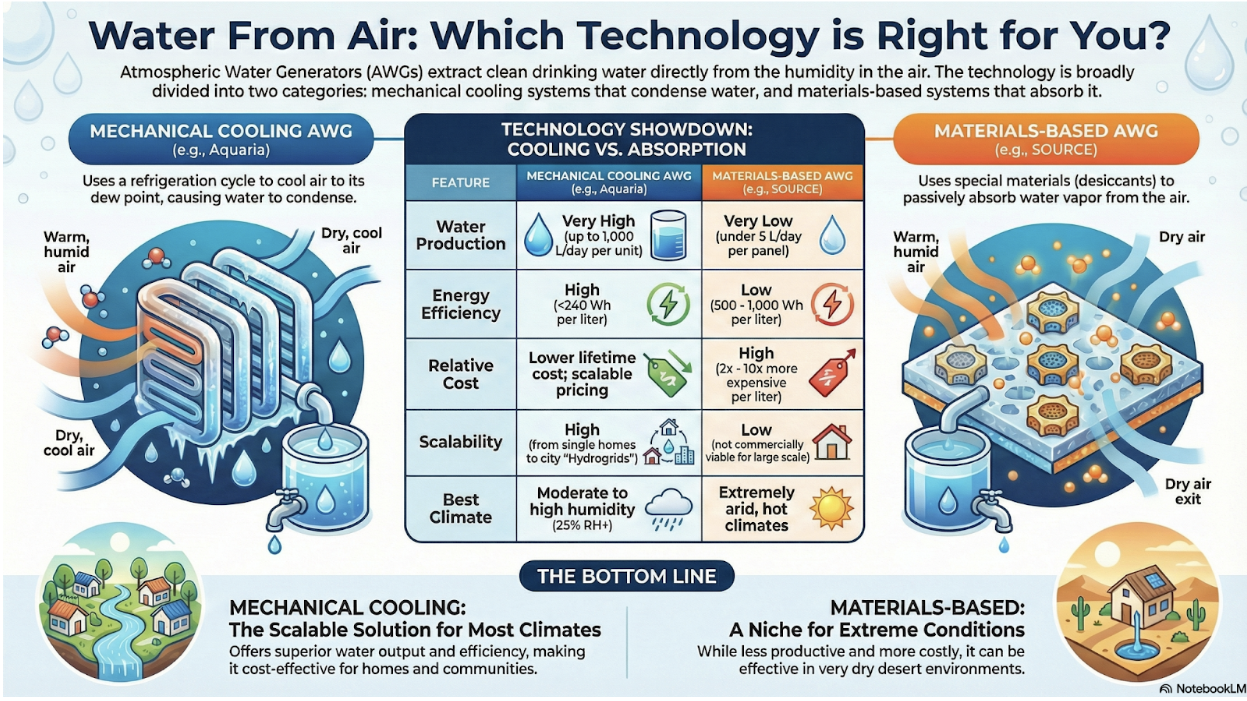
Categorization of AWG Technologies
Atmospheric water vapor represents a massive, naturally regenerating resource, with an estimated 37.5 million-billion gallons of water in the atmosphere at any given time. To extract this water, current technologies are broadly divided into two categories: mechanical-based (cooling) and materials-based (desiccant) systems.
1. Mechanical-Based AWG (Cooling)
Mechanical systems are the industry standard for high-volume water production. They operate on a refrigerant cycle to extract moisture.
- The Science of Dew Point: Ambient air is drawn into the system and passed over an evaporator, where it encounters a cooler refrigerant. This process transfers heat energy from the air to the refrigerant, cooling the air below its dew point, or the temperature at which water vapor undergoes a phase change into liquid.
- The Refrigeration Cycle: The system consists of an evaporator, a compressor to increase refrigerant pressure and temperature, and a condenser where exhaust air absorbs heat from the refrigerant to cycle it back into a liquid.
2. Materials-Based AWG (Desiccants)
Materials-based systems focus on the ability of specific substances to passively absorb water from the air.
- Common materials: silica gel, hydrogels, hygroscopic salts, and Metal-Organic Frameworks (MOFs).
- Unlike mechanical systems that cool the air, desiccant systems capture water molecules at ambient temperatures. However, energy must then be applied, often via solar thermal heat or powered fans, to release the captured water for collection.
(Sources: WE Forum, Ahrestani et al)
Why Mechanical AWGs Lead the Market
- High Costs: Many MOFs remain in the laboratory stage as they are expensive to synthesize (with some MOFs costing between $500/kg and $880/kg)
- Space Inefficiencies: Low water production capacity relative to the machine's physical footprint.
- Low Yield: The inherent technical limitations of the dessicant-based AWG approach mean that systems can only produce a small amount of water, limiting their practical applications
Frequently Asked Questions
What is the most energy-efficient atmospheric water generator technology, mechanical or materials-based?
Currently, mechanical cooling systems are the most energy-efficient for high-volume production of water, particularly in humid and moderate climates. They utilize established refrigerant cycles to maximize water output per kilowatt-hour.
Is atmospheric water safe to drink?
Yes, once filtered. Most commercial AWGs, such as those from Aquaria, include multi-stage filtration and UV sterilization to ensure the water is free from contaminants like PFAS, microplastics, and bacteria. Further, water made from air (also known as “air-water”) is naturally cleaner than groundwater or rainwater. As surface water evaporates, it leaves behind heavier molecules as it becomes atmospheric humidity. Compared to rainwater, air-water is also cleaner by nature. Rainwater already contains contaminants in the sky because both cloud formation and the raindrop’s fall involve contact with particles and gases in the atmosphere, not just with surfaces on the ground.(source: National Institute of Health)