
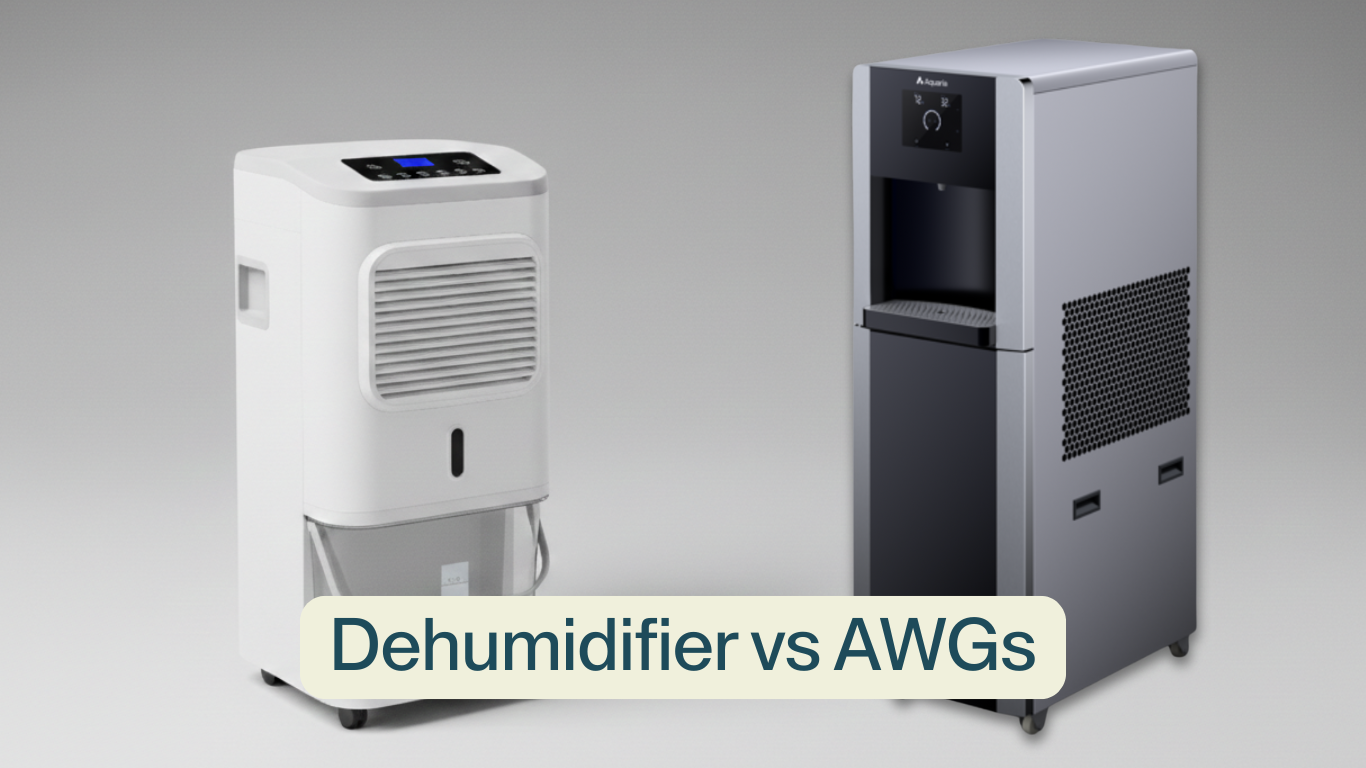
If you’ve ever researched atmospheric water generators (AWGs), you’ve probably seen this comparison come up: “Isn’t an AWG just a dehumidifier with a filter?”
It’s a fair question. Both systems pull moisture from the air, use electricity, and rely on heat exchange. In fact, they even share some core components—compressors, evaporators, and condensers—the same fundamental parts used in advanced systems like rocket engines. But sharing components doesn’t mean the systems are interchangeable. Vapor-compression refrigeration cycles are designed into mission-critical applications in Aerospace, Defense and Transportation, and Medicine as well as AWGs, and – yes – dehumidifiers.
When you look at design purpose, scale, and safety, the differences between dehumidifiers and purpose-built atmospheric water generators become clear.
- AWGs and dehumidifiers share some core components (compressor, evaporator, condenser), the same heat-exchange parts found in systems as advanced as rocket engines.
- Shared components do not mean shared purpose. Technology is defined by application, scale, materials, and engineering intent.
- A dehumidifier is built to reduce indoor humidity, treating collected water as waste. It is not drinking-water safe by default due to non-food-grade materials, open storage, and lack of continuous purification. Adding filters to a dehumidifier doesn’t make it a potable water system.
- An atmospheric water generator (AWG) is built to produce drinking water, where water is the end product.
- AWGs are designed for reliability and scale, producing consistent daily volumes suitable for household use or larger applications.
This article explains why atmospheric water generators and dehumidifiers are fundamentally different systems, when each one makes sense, and why some Texas homeowners are choosing purpose-built AWGs like Aquaria’s Hydropack and Hydropixel for reliable drinking water at home.
Why People Compare AWGs to Dehumidifiers
People compare atmospheric water generators (AWGs) to dehumidifiers because both systems condense moisture from the air. At a physics level, that overlap is real. Both rely on heat exchange, and at the core, they may use similar components:
- A compressor
- An evaporator
- A condenser
These same components are found not only in dehumidifiers, but also in air conditioners, industrial heat-exchange systems, and even rocket engines.
However, shared components do not mean shared purpose.
Technology is defined by application, scale, materials, and engineering intent—not just by the parts involved. Here’s a helpful analogy:
A dehumidifier and an atmospheric water generator are like a Toyota Corolla and a Formula One car.
Both have engines.
Both rely on the same fundamental mechanical principles.
But they are built for entirely different outcomes.
A dehumidifier is engineered to reduce indoor humidity in a confined space. Any water collected is incidental and treated as waste.
An atmospheric water generator is engineered to produce potable water as its primary output—using food-grade materials, controlled condensation, purification, and safe storage designed for daily consumption.
This is why the comparison is common, but ultimately misleading. While both systems may condense moisture from air, only an atmospheric water generator is designed, built, and evaluated as a drinking water system.
AWGs, Dehumidifiers, MRIs, and Jets Use The Same Core Technology
Many mission-critical technologies and products use the vapor-compression refrigeration cycle (leveraging compressors, evaporators, condensers and other components) because it is a foundational industrial technology.
Below are advanced technologies leveraging vapor-compression refrigeration cycles.
Aerospace, Defense & Transportation
Commercial Aircraft Environmental Control Systems (ECS)
Used to regulate cabin temperature and airflow on commercial aircraft, often via electric or hybrid vapor-compression cycles. These systems are mission-critical and safety-certified.
High-Performance Electric Vehicle Thermal Management Systems
Thermal systems that manage battery cooling and cabin air conditioning in electric vehicles. Typically involve advanced compressors and multi-loop architectures.
Military Ground Vehicle Climate & Electronics Cooling
Hardened vapor-compression systems designed to cool personnel compartments and sensitive electronics in extreme operating environments.
Luxury & Performance Automotive HVAC Systems
Multi-zone HVAC and heat-pump-based systems used in premium and performance vehicles, optimized for comfort, efficiency, and noise control.
Medical & Life Sciences
MRI and CT Scanner Cooling Systems
Precision thermal control systems used to stabilize superconducting magnets and high-power electronics in imaging equipment.
Pharmaceutical Cold-Chain Storage
Ultra-low and controlled-temperature refrigeration systems used for vaccines, biologics, and gene therapies.
Hospital Operating Room Climate Control
Chilled systems designed to maintain tight temperature and humidity tolerances in surgical environments.
Data, Computing & Electronics
Data Center Chillers
Air- or liquid-cooled chillers forming the backbone of hyperscale and enterprise computing infrastructure.
High-Performance Computing (HPC) & AI Cluster Cooling
Direct-to-chip, rear-door, or immersion cooling systems often supported by vapor-compression chillers.
Semiconductor Fabrication Facility Cooling
Highly stable thermal systems providing sub-degree temperature control for semiconductor manufacturing processes.
Industrial & Scientific Systems
Industrial Process Chillers
Cooling systems used in plastics processing, laser equipment, CNC machining, and chemical manufacturing.
Cryogenic Pre-Cooling Systems
Hybrid systems where vapor-compression stages pre-cool gases before cryogenic temperatures are reached.
Climate Test Chambers & Environmental Simulation Labs
Environmental control systems used for aerospace, automotive, and defense qualification testing.
Buildings & Infrastructure
Commercial & District Cooling Chillers
Large-scale cooling systems serving airports, hospitals, campuses, and urban districts.
Geothermal & Air-Source Heat Pumps (Commercial Scale)
Advanced vapor-compression systems used for building heating and cooling in decarbonization efforts.
Water & Environmental Technologies
Atmospheric Water Generators (AWGs)
Water production systems that extract moisture from air using refrigeration and condensation physics.
Industrial Dehumidification Systems
Desiccant and vapor-compression systems used in lithium battery plants, food processing, and pharmaceutical manufacturing.
How an Atmospheric Water Generator Is Fundamentally Different
Another common misconception is that atmospheric water generators are simply small appliances. In reality, properly designed AWGs are engineered as water systems, scaled from residential use all the way to utility-grade production.
That may be true for small standalone models. It’s not true for residential-scale, integrated atmospheric water generators that tie into plumbing and electrical systems. An atmospheric water generator like Aquaria is designed from the ground up to produce clean, drinkable water efficiently at scale, not as a by-product, but as its sole purpose.
For example:
- Hydropixel produces ~10 gallons per day, designed for small household, can be placed indoor like your water cooler and it’s a plug-and-play machine
- Hydropack S produces ~66 gallons per day, can be used for your entire household water needs or as a backup water source
- Hydropack and Hydropack X produces ~ 264 gallons per day, supporting full large household demand
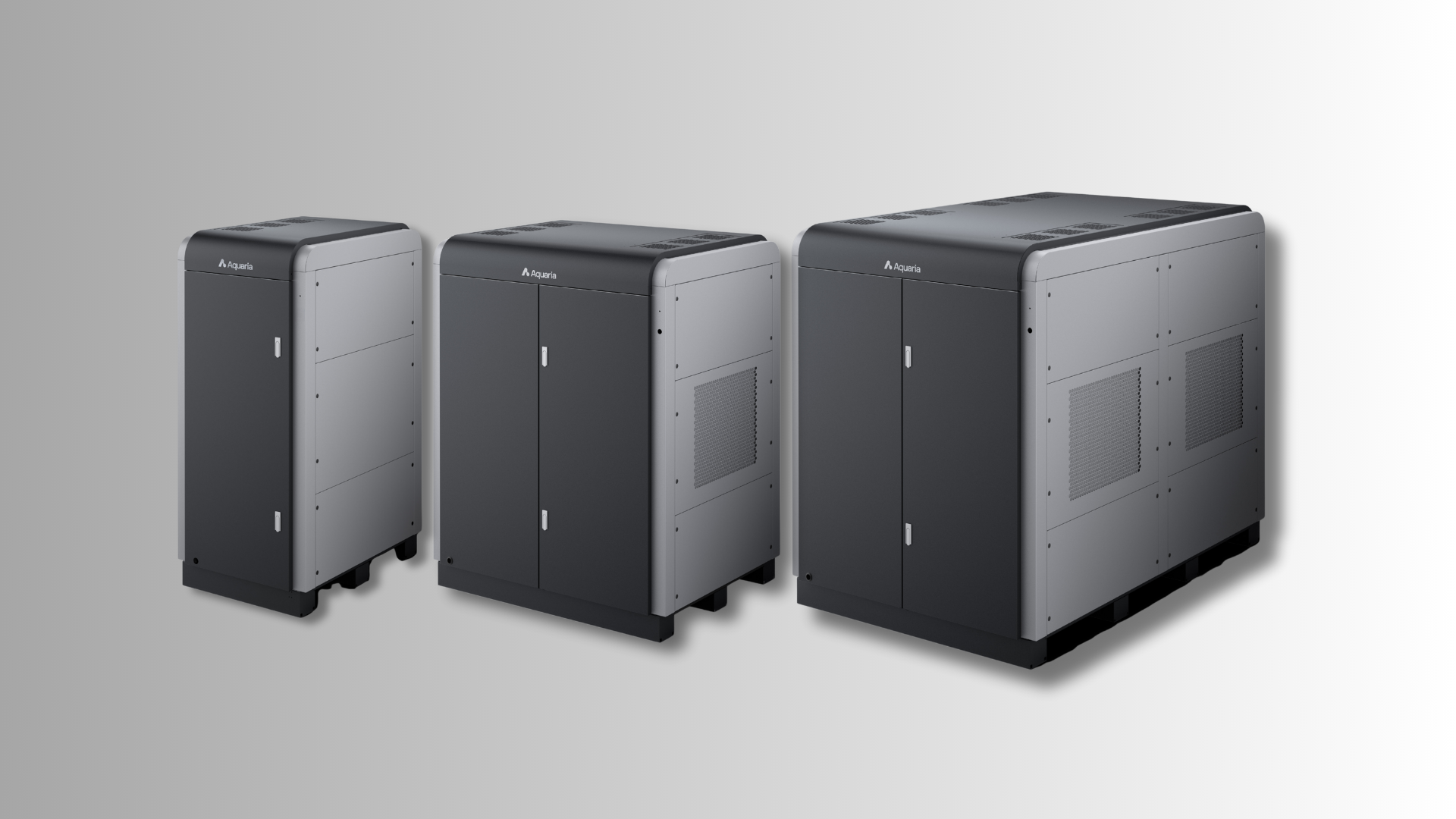
These systems are designed around daily consumption, not novelty output.
Here’s How Aquaria AWG Works
Aquaria’s atmospheric water generators are designed as complete drinking-water systems, not moisture-collection appliances. The process is purpose-built for consistency, safety, and daily household use.
In short, here’s how it works:
- Air intake & filtration: The system draws in ambient air and filters out dust, particulates, and airborne contaminants before any water is collected.
- Controlled condensation: Using high-efficiency heat exchange, water vapor in the air is condensed into liquid—similar to how dew forms, but optimized for reliable daily production.
- Drinking-water purification: The collected water passes through multi-stage purification designed specifically for potable use, producing water that exceeds EPA and WHO drinking water standards.
- Safe storage & use: Clean water is stored in a protected system and dispensed directly or connected to household plumbing, depending on the model.
This end-to-end design—air filtration, condensation, purification, and secure storage—is what separates Aquaria’s systems from devices that merely collect moisture as a by-product.
Want to see the full process in detail? Explore how Aquaria works for a deeper breakdown of the technology.
Why This Difference Matters for Homeowners
The difference between an atmospheric water generator and a dehumidifier isn’t simply how water is collected, it’s what the system is designed to deliver.
A dehumidifier treats water as waste. An AWG treats water as the end product.
Because Aquaria’s systems are engineered specifically for drinking water, every stage, from air intake to storage, is built around consistency, water quality, and daily household use. That’s why AWGs are evaluated like water systems, not appliances, and measured in gallons per day rather than occasional output.
For homeowners, this difference matters far more than the shared physics.
The question isn’t whether a dehumidifier can collect water from the air. It’s whether a system is designed to reliably produce safe, drinkable water for your household, every day. That’s the difference between a humidity-control appliance and a purpose-built atmospheric water generator.

See What Makes Sense for Your Home
Every home has different water needs, shaped by climate, household size, and how water is used day to day. If you’re considering an atmospheric water generator like Hydropixel or Hydropack, the best next step is a simple water assessment.
It helps determine:
- How much water your household actually needs
- Which system size fits your lifestyle
- Whether an AWG makes sense as a primary source, backup, or resilience layer
Request a personalized water assessment to get clear answers for your home needs.
Frequently Asked Questions
1. Is an atmospheric water generator just a dehumidifier with filters?
No. While both systems condense moisture from the air, they are designed for entirely different purposes. A dehumidifier is built to reduce indoor humidity, and any water collected is a by-product. An atmospheric water generator is engineered from the start to produce drinking water, using food-grade materials, closed-loop purification, and controlled storage designed for daily household use.
2. Why isn’t dehumidifier water considered safe to drink?
Dehumidifiers are not designed as drinking water systems. Most use internal components that are not food-grade, store water in open or warm tanks, and lack continuous sanitation or purification. Because water safety was never the intended outcome, manufacturers and public guidance generally advise against consuming dehumidifier water.
3. When does an atmospheric water generator make sense for a home?
An atmospheric water generator makes sense when homeowners want a predictable, on-site source of drinking water without relying on groundwater quality, delivery schedules, or aging infrastructure. Properly sized AWGs are designed to produce consistent daily volumes and can serve as a primary water source, a backup supply, or a resilience layer depending on household needs and local conditions.
Sources & Further Reading
If you’d like to explore the science and standards behind the technologies discussed in this article, these resources offer deeper context.
- Rotary Vapor Compression Cycle Technology, U.S. Department of Energy
- CYCLE_D-HX Vapor-Compression Cycle Model, National Institute of Standards and Technology
- Best Practices Guide for Energy-Efficient Data Center Design, U.S. Department of Energy
- Performance Analysis of Atmospheric Water Generators Under Hot and Humid Climate Conditions, ScienceDirect
- Drinking Water Regulations, EPA
- Drinking-Water Quality Guidelines, WHO